CORN 3000
· An Almanack Perpetual · Being a faithful record of one farmer's years upon the Corn Belt ·
Ninety years.
One farm.
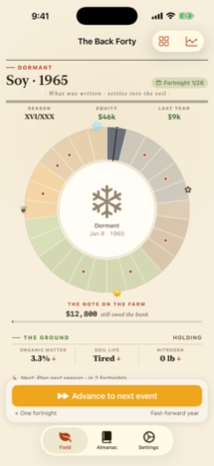
A telegram arrives: your grandfather's quarter-section passes to you — the team, the barn, the herd, and the mortgage with it. Pick your year, 1930 to the present. Pick your state. Farm it for thirty seasons.
- The real numbers
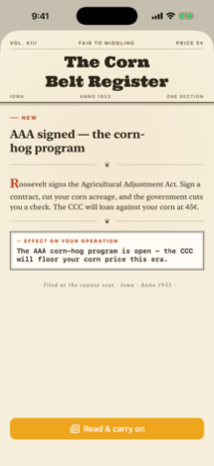
- Every coefficient is cited. USDA yields and prices, NOAA weather, the actual farm bills — the AAA corn-hog contract, the CCC loan floor at 45¢, deficiency payments, ARC and PLC. When the paper promises a price floor, the ledger keeps the promise.
- The ground remembers
- Field-by-field soil that builds or breaks under your practice. Rotation, manure, cover crops, and lime move the organic matter — and the organic matter moves the yield, for decades. Mine it and the crop starves; keep it in good heart and it carries you.
- Kitchen-table decisions
- Sign with the insurance agent. Sell off the combine or bin it and carry to March — the board at the scale house quotes your odds. Sow rye after harvest. Every card is a real decision with its numbers on it; anything with one answer answers itself.
- The books foot
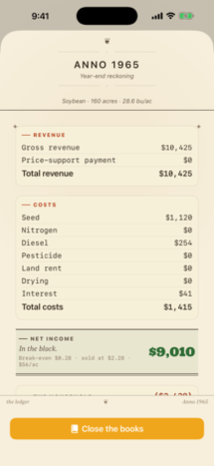
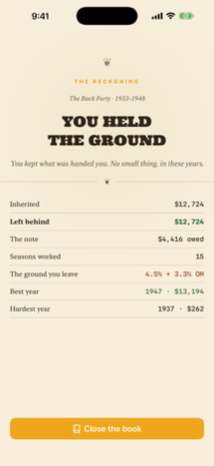
- Year's end brings a ruled ledger that accounts for every bushel: what the weather took, what the rotation paid, what your own hands moved — down to the bushel, with a hand-star ✳ on the lines you chose.
- History arrives
- The Dust Bowl, the war years, the 1970s boom, the farm crisis at 15% interest, the ethanol run. Survive them in order or start inside one — the era tells you what it costs before you sign.
- Yours alone
- Entirely on your device. No ads, no accounts, no tracking, no in-app purchases, nothing sold but the app. The privacy policy is one page because there is nothing to disclose.
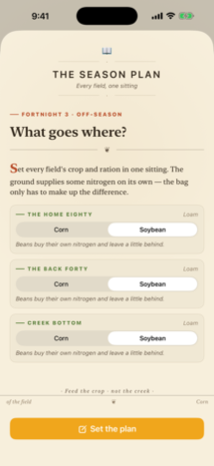
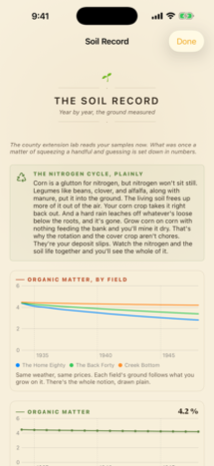
Corn 3000 was built the way an extension bulletin is written: nothing ships without a source. Yield response to nitrogen follows Cerrato & Blackmer's linear-response-plateau. Land values follow the USDA-NASS series through the 1920 peak, the Depression trough, and the 1980s crash. The insurance agent quotes real subsidy schedules; the haymaking bill comes off the Iowa custom-rate survey. If we couldn't cite it, we didn't ship it.
Which means the game teaches the real thing: why rotations pay, why the 1979 land buyer met the auctioneer in 1985, and why the paying rate on nitrogen is enough, not the most.
Questions, trouble, or corrections to the record: write jeff@river.io and a human will answer. The privacy policy is the shortest page on this site.
· A STALK PALE IN JUNE · A BIN LIGHT IN OCTOBER ·